
Equity investors suffered a massive loss of Rs 31 lakh crore on Tuesday as markets went into a tailspin with the BSE Sensex tumbling nearly 6 per cent as vote counting trends showed the BJP may not have a clear majority in the Lok Sabha polls. Erasing the record-rally of the previous trade, the 30-share BSE Sensex cracked 4,389.73 points or 5.74 per cent to settle at 72,079.05. During the day, the benchmark tanked 6,234.35 points or 8.15 per cent to hit a nearly five-month low of 70,234.43.

'As the global economy undergoes significant transformations in 2025, India's ability to navigate the complexities of trade wars, financial realignments, and emerging blocs will be pivotal,' explain Harsh V Pant and Soumya Bhowmik.

Trump's tariff threats spooks markets; Sensex down 106 points

With nearly a quarter of U.S. energy shares' value wiped out by oil's six-month slide, investors are wondering if the sector has taken enough punishment and whether it is time to pile back in ahead of earnings reports later this month.

Global factors and FII activity will dictate trends in domestic equity markets this week while assembly poll results of Maharashtra and Jharkhand may impact stocks on Monday, say analysts. Stock markets witnessed a spirited recovery on Friday with benchmark Sensex and Nifty notching the best single-day gains in more than five months and offering relief after weeks of correction.

Global head of equity strategy at Jefferies, Christopher Wood, has cut his exposure to Indian equities by one percentage point in the Asia-Pacific ex-Japan relative-return portfolio, and Australia and Malaysia by half a percentage point each in favour of China, which has seen a hike in exposure by two percentage points. The rally in China has been fast-forwarded by the approach of a seven-day holiday with the CSI 300 Index up 8.5 per cent on Monday, and 25.1 per cent in five trading days, he said.

Larsen & Toubro, Axis Bank, Reliance Industries, UltraTech Cement, Mahindra & Mahindra, IndusInd Bank, ICICI Bank and Tata Steel were the other big gainers. Sun Pharma, HCL Technologies, Asian Paints, Nestle and Infosys were the laggards.

All sectoral indices ended lower. BSE Telecommunication tanked 2.18 per cent, metal (1.77 per cent), auto (1.70 per cent), energy (1.64 per cent), oil & gas (1.59 per cent), commodities (1.39 per cent) and financial services (1.37 per cent) were the major laggards.

Investors are showing some interest in the downstream energy cycle. Refiners and marketers, especially the public sector (PSU) oil marketing companies (OMCs) could see a revival of marketing margins. Lower crude oil and gas prices may also improve margins in industries like paints, logistics, synthetic fabrics, plastics, and fertilisers. In the medium-term, however, there could be a supply overhang affecting OMCs as new refining capacities are scheduled to be commissioned, especially in China, and this may lead to a drop in the refining margins as capacity would be surplus to demand until and unless there's a pick-up in global growth.

Global brokerage firm CLSA has reversed its early tactical shift from Indian equities to Chinese stocks, and has decided to raise India allocation while cutting exposure to China. In its report titled 'Pouncing Tiger, Prevaricating Dragon', CLSA cited challenges facing Chinese markets in the aftermath of Donald Trump's victory in the US elections as the reason for the move. "Misfortune can happen in threes. So it has played out for Chinese equities over the past week.

'The biggest near-term risk to Indian equities is the outflow of investments to China as tactical trades by foreign investors.'

Quarterly earnings from corporates, global trends, and trading activity of foreign investors will guide market sentiment this week, analysts said, adding that benchmark indices may face volatile trends. "The upcoming release of Q2 results will be closely watched, providing insights into corporate performance. "Meanwhile, the escalating tensions between Israel and Iran introduce a significant geopolitical risk, potentially leading to increased oil prices and market volatility.

After a strong run in the midcap and smallcap indices, which surged 46 per cent and 43 per cent, respectively, on the National Stock Exchange (NSE) during Samvat 2080, analysts suggest that the rally in these segments may pause to catch its breath in Samvat 2081.

NTPC was the biggest gainer on the Sensex chart, rising 2.44 per cent, followed by JSW Steel, Larsen & Toubro, ICICI Bank, Axis Bank, Nestle, Mahindra & Mahindra and Tata Steel. Bajaj Finance declined over 3 per cent. Hindustan Unilever, Bajaj Finserv, Adani Port and Asian Paints were the other laggards.
'We are in a sweet spot.' 'Equity, on a standalone basis, will continue to remain the asset class to stay invested in.'

From 30 Sensex firms, Adani Ports, NTPC, Power Grid, State Bank of India, Nestle, Mahindra & Mahindra, Reliance Industries and Tata Consultancy Services were the biggest laggards. Axis Bank, Infosys, JSW Steel, Tata Motors, HDFC Bank and Kotak Mahindra Bank were among the gainers from the blue-chip pack.

Billionaire Mukesh Ambani on Monday laid bare the succession plan at India's most valuable company, identifying twins children Akash and Isha for telecom and retail leadership, and youngest son Anant for new energy unit. He, however, insisted he isn't retiring yet and will "continue to provide hands-on leadership as before". At the annual shareholders' meeting of Reliance Industries Ltd, he said the robust architecture that he has announced will ensure the firm remains "a unit, well-integrated and secure institution even as it develops existing businesses and adds new growth engines."

Why does the world's fastest-growing major consumer of energy fail to attract investments in oil and gas? This is a question worth pondering after private sector conglomerate Reliance Industries Ltd (RIL) failed to close a $15-billion downstream asset deal with Saudi Arabia's national oil company, Aramco. It's understandable if multi-billion dollar investments in oil and gas projects or deals involving state companies that need to traverse a complex bureaucracy at state and federal levels and the corridors of ministries unravel. However, Mukesh Ambani-run RIL, India's most successful energy company, is not typically known to fumble on closing deals (Ambani closed deals worth around Rs 2 trillion early last year in telecom and retail with blue chip investors).

Benchmark BSE Sensex rallied nearly 630 points while Nifty closed above the 16,500 mark on Wednesday after sharp gains in IT and energy shares amid positive global market trends. Buying in index majors Reliance Industries, Infosys and Tata Consultancy Services and FII inflows bolstered the sentiment. Shares of firms related to oil exploration and refineries were in heavy demand, with Reliance Industries rallying 2.47 per cent and ONGC by 4 per cent, as the government slashed windfall tax on petrol, diesel, jet fuel and crude oil.

Stock market investors became poorer by Rs 8.30 lakh crore as equities continued their slide for the sixth consecutive day on Friday. The BSE Sensex has tumbled 1,855.58 points or 3 per cent since February 16. During this period, the combined market capitalisation of BSE-listed firms has tanked Rs 8,30,322.61 crore to reach Rs 2,60,00,662.99 crore. "The domestic market is broadly demonstrating a lack of confidence, registering its sixth consecutive day of losses despite global markets turning green.

From the 30 Sensex firms, Mahindra & Mahindra, Bajaj Finance, Asian Paints, Nestle, Bharti Airtel, UltraTech Cement, Hindustan Unilever, ITC, and HDFC Bank were the major laggards. In contrast, Infosys, Tech Mahindra, Tata Motors, Axis Bank, Tata Consultancy Services and State Bank of India were among the gainers.

'Investors looking at the next 6-12 months can be certain that the Fed will maintain its easing cycle, and we expect the overall environment to be conducive for fixed income investments for portfolio diversification.'

The wider NSE Nifty touched a low of 10,652.40 before finishing at 10,671.40, showing a loss of 97.75 points, or 0.91 per cent.
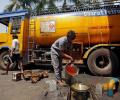
The medium-term scenario for oil marketing companies (OMCs) is high risk due to the surging crude and gas prices. Apart from OPEC-plus cutting production, the Hamas-Israel conflict has caused fears of supply disruption. The July-September quarter of 2023-24 (Q2FY24) saw positive surprises for OMCs. Strong gross refining margins (GRMs) more than offset weak marketing margins.

Benchmark equity indices Sensex and Nifty slumped over 1 per cent on Friday, tracking a weak trend in global markets and fresh foreign fund outflows. Falling for the third day running, the 30-share BSE Sensex tumbled 1,017.23 points or 1.24 per cent to settle at 81,183.93.

Consolidated earnings for oil-to-telecom conglomerate Reliance Industries (RIL) may report sequential weakness, and modest year-on-year (Y-o-Y) growth in the June 2024 quarter (Q1FY25), said analysts. Lower refining margins are expected to moderate gains made from other businesses. RIL is slated to report its financial performance for Q1FY25 on July 19.

'Retail investors, who had not seen such a massive correction in the SMID universe since COVID-19, are witnessing something like this for the first time. Panic profit booking may continue.'

On the Sensex chart, L&T, ONGC, HCL Tech, NTPC, Axis Bank and Infosys were major gainers. NSE Nifty ended with a gain of 18.10 points at 14,956.20.

'If weak indicators persist, there is a risk that India could slip into a prolonged slowdown similar to the one experienced between 2014 and 2019,' warns Debashis Basu.

Reliance Industries Ltd, whose offering of rock-bottom tariffs shook up the telecom industry, is looking to repeat the feat in the green energy business, where its billionaire chairman Mukesh Ambani sees promise to outshine all existing growth engines in 5-7 years. Having pledged Rs 6 lakh crore on green energy, Ambani says RIL will scale up investments in this business which will start going live in the next 12 months. "Over the next 12 months our investments across the Green Energy value chain will gradually start going live, scaling up over the next couple of years," Ambani, chairman and managing director of RIL, said in the company's latest annual report.
Falling the second consecutive session, equity benchmark Sensex dropped over 140 points on Friday, tracking weakness in banking and energy stocks amid a mixed trend overseas. Investors also remained concerned over persistent foreign fund outflows, traders said. The 30-share BSE index ended 143.20 points or 0.24 per cent lower at 58,644.82. Similarly, the NSE Nifty shed 43.90 points or 0.25 per cent to close at 17,516.30.

A sharp sell-off in the Indian equities markets after a spike in crude oil prices should not be surprising. Historically there is a negative correlation between stock valuations in India and the price of Brent crude oil, which is the benchmark for the Indian crude oil basket. Between 2011 and 2014, crude oil traded above $100 a barrel for an extended period, the Sensex-trailing price/earnings (P/E) was 18X, on average, during the period, nearly 22 per cent lower than the current index P/E of 23X.

From the Sensex basket, Maruti, Mahindra & Mahindra, NTPC, JSW Steel, Larsen & Toubro, Reliance Industries, Axis Bank, and Power Grid were the major gainers. Nestle, Wipro, Tata Consultancy Services, HDFC Bank, Titan, HCL Technologies and Infosys were the laggards.

Among the 30 Sensex companies, Axis Bank, HDFC Bank, ICICI Bank, Kotak Mahindra Bank, IndusInd Bank, State Bank of India, Infosys, Wipro, Tech Mahindra and HCL Technologies were the gainers. On the other hand, Titan, Maruti, Bharti Airtel, Larsen & Toubro, NTPC, Reliance Industries, Bajaj Finance and Power Grid were among the laggards.

Ultratech Cement was the top gainer in the Sensex pack, surging nearly 3 per cent, followed by M&M, Maruti, Tata Steel, TCS, L&T, SBI and HUL. NSE Nifty advanced 52.35 points to 18,308.10.

Stocks of Hindustan Petroleum Corporation Limited (HPCL), Bharat Petroleum Corporation Limited (BPCL) and Indian Oil Corporation Limited (IOCL) have more headroom left despite the sharp run in the last few weeks, suggests a recent report from Morgan Stanley. Stocks of these oil refining and marketing companies (OMCs), it believes, are seeing multiples re-rate as investors reassess long-term growth prospects. "IOCL trades at one year forward P/BV of 1.2x, 19 per cent below +1 standard deviation (SD); BPCL trades at one year forward P/BV of 1.5x, near historical averages; HPCL trades at one year forward P/BV of 1.5x, near +1SD," Morgan Stanley said.
From the Sensex basket, ITC, Kotak Mahindra Bank, Bharti Airtel, State Bank of India, Asian Paints, Tech Mahindra, Reliance Industries and Nestle were the major gainers. Maruti, HDFC Bank, Larsen & Toubro and Mahindra & Mahindra were among the laggards.

Adani group opened a $1.2 billion copper plant, bought a port in Odisha, raised stakes in a cement company and stitched an alliance with rival Mukesh Ambani's Reliance Industries, all in a matter of one week in signs that the apples-to-airport conglomerate has shrugged off the Hindenburg effect and is back to rapid expansion spree. In the last one week, Adani group has through regulatory filings and press statements announced expansions and investments in its mainstay ports business, diversification into metal refining, fund infusion into a two-year-old cement foray and continuing progress in the commissioning of its mega solar project.

'Those betting against PSUs will likely be punished in this upswing.'

'We expect market consolidation and recommend buying during market dips.'
 © 2026 Rediff.com - Advertise with us - Disclaimer - Privacy Policy - Sitemap - Feedback - About us - Terms of use - Grievances